The approach
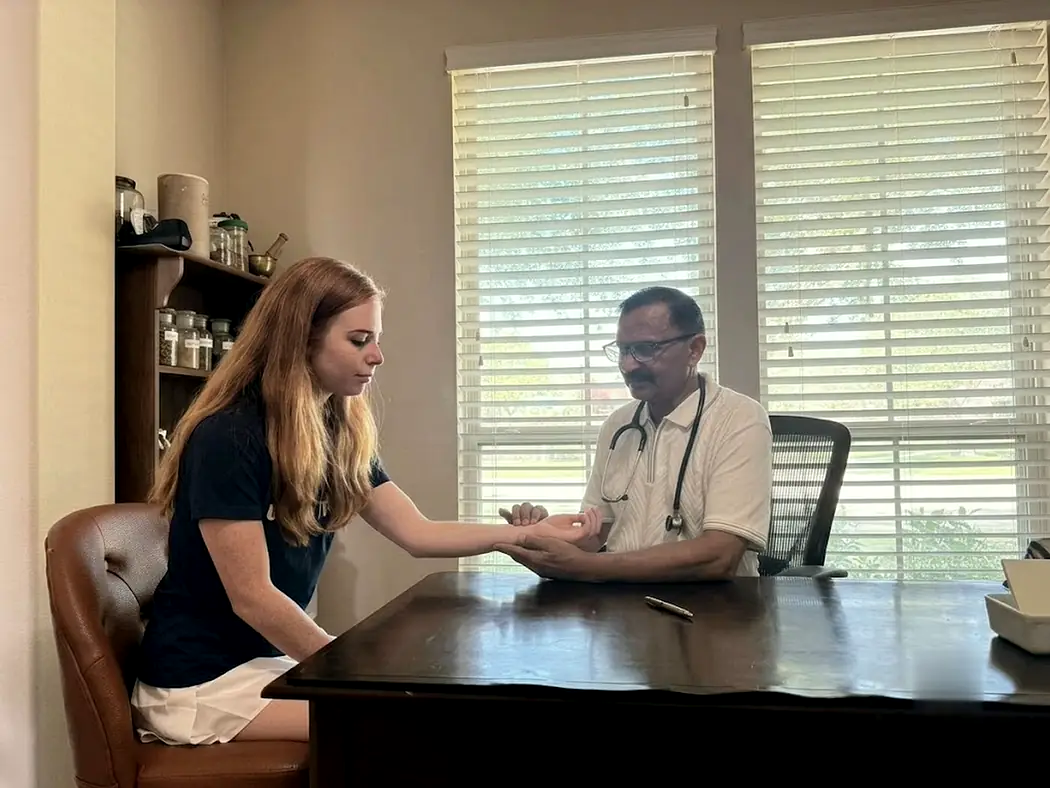
He puts two fingers on your wrist and stops talking for a while.
That is the part people ask about, so here it is first. Reading the pulse — Nadi Pariksha— is how an Ayurvedic practitioner works out where the imbalance is: not the heart rate a machine gives you, but the quality of the beat under the fingers.
It is an old skill and it is done by hand, which is why the first part of a visit here is a pause rather than a form on a tablet.
In order
What happens, step by step.
- First
- You sit down opposite him and say what has been going on. He listens and asks questions.At the desk
- Then
- He reads your pulse by hand.Both hands
- Then
- Blood pressure, taken at the desk, and other basic observations.Manual cuff
- Then
- He writes it all on the practice’s intake form.On paper
- Then
- He tells you what he found, and what he suggests you change.In plain words
- You leave with
- A plan you understood while it was being explained to you.
- How long it takes
- confirmed when you book
In case you were about to look these up
Three words, once each.
You will meet these on other Ayurveda sites without explanation. You should not have to search mid-sentence.
- Nadi Pariksha
- Pulse reading. Feeling the pulse at the wrist to judge the quality of the beat, not just its rate. The practice calls it “pulse reading” — so do we.
- Dosha
- Ayurveda’s way of describing a person’s constitution and where it has tipped out of balance. You do not need to know your own to book.
- Ayurveda
- A system of practice from South Asia built on diet, routine, herbs and movement. Here it is supportive care alongside whatever else you do.
What this is not
Dr. K. B. Singh is an Ayurvedic practitioner. He is not a licensed physician, and Ayurvedic practice is not licensed by the State of Texas. He does not prescribe pharmaceuticals, order imaging, or diagnose disease.
Nothing that happens here replaces medical care, and nothing on this site is a diagnosis, a treatment or a promise of a result. Keep your doctor. If something is urgent — chest pain, a bad fall, anything frightening — go to a physician or an emergency room, not here.
We put this on its own section rather than in small print at the bottom, because a practice that is straightforward about its limits is easier to trust about everything else.
Ayurveda is complementary care. It is not a substitute for medical diagnosis or treatment, and nothing here is a diagnosis. Ask us anything before you book.
Nothing to lose by finding out what he reads.
The first pulse reading is free, by appointment in Pearland. Tell us what has been going on and we will come back to you with a time.
First reading is free. No card, no obligation.